You saw a hero section on Linear. You saw a pricing table on Stripe. You saw a navbar on Vercel. You want them in your project — not as inspiration, but as actual code you can paste into Cursor and ship today.
Here's the exact workflow for copying a single section from any live website straight into your editor as clean Tailwind HTML.
The 30-second workflow
- Hover the section you want — hero, pricing, navbar, footer, testimonial grid, anything.
- Click to capture it.
- Paste into Cursor, Claude, or v0 with one sentence of context.
That's it. Real class names, real values, real structure. No DevTools archaeology, no screenshot guessing.
Why section-level extraction beats element-level
When you extract a single button or single card, you lose the layout context — the grid, the spacing rhythm, the responsive breakpoints. Section-level extraction (hero, pricing tier, navbar) preserves the parent container and everything inside it, so the AI gets the full composition.
A pricing section isn't three cards. It's three cards inside a grid with specific gaps, padding, max-widths, and breakpoint behavior. Copying the whole section gets you all of that. Copying one card forces you to rebuild the layout by hand.
How to copy a hero section
Heroes are the most-extracted section type — they set the tone of a landing page and they're hard to design from scratch.
1. Find a hero you like
Open the site. Linear, Stripe, Vercel, Apple, Notion — anything with a hero you'd happily ship a variant of. Want curated picks? Browse the feature inspector on miromiro.app for examples we use daily.
2. Hover until the whole hero is highlighted
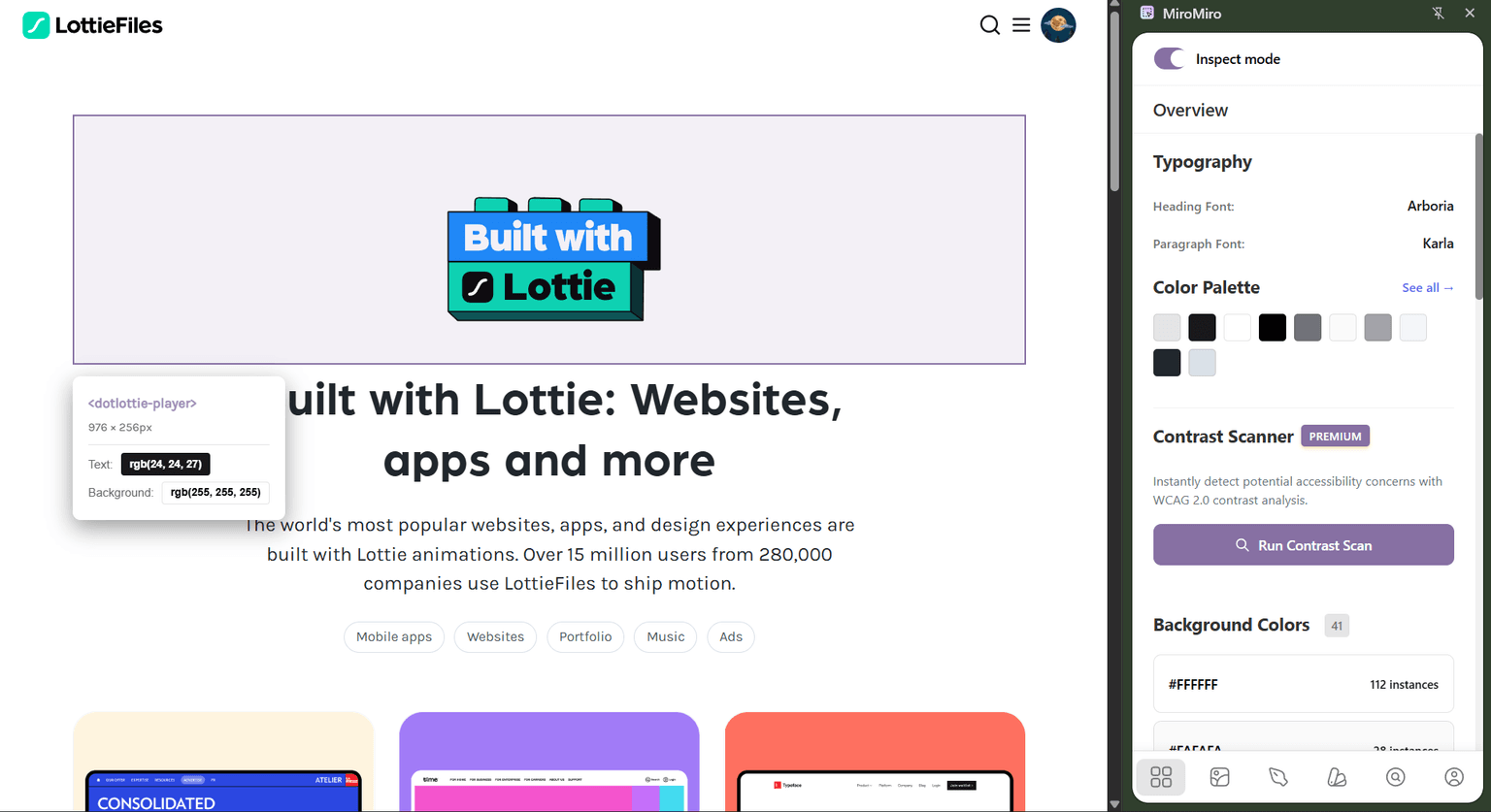
Install MiroMiro and click its toolbar icon. As you hover, MiroMiro highlights the element under your cursor with dimensions and a live preview. Move up the DOM tree (hovering further out) until the entire hero — heading, subheading, CTA, hero image or animation — is inside the highlight. Click.
3. Export as Tailwind HTML
MiroMiro converts the live DOM into clean, semantic Tailwind HTML. Real hex values, real spacing tokens, real font weights — not the rounded approximations Figma exports give you. One click copies it to your clipboard.
4. Paste into Cursor
Drop the markup into a .tsx or .vue file and prompt Cursor: "Adapt this hero section to my brand colors from tailwind.config.ts and replace the copy with your headline." Because Cursor is reading real Tailwind classes — not interpreting a screenshot — the output matches what you saw.
For a deeper look at why this beats screenshot-to-code in every AI tool, see the export-to-code guide.
How to copy a pricing section
Pricing tables are notoriously fiddly: aligned tiers, highlighted middle plan, feature checklists, responsive collapse on mobile. Building one from scratch is a half-day. Extracting one is 30 seconds.
The same flow works:
- Hover the pricing section until the entire 3-tier grid is highlighted (you may need to hover progressively further out to capture the full grid container, not just one card).
- Click to capture.
- Paste into Cursor and prompt: "Wire this pricing section to my Stripe products in
lib/stripe.tsand use my plan names: Free, Pro, Team."
The structure is preserved — three columns at desktop, stacked on mobile, highlighted middle plan, feature checklists. Cursor swaps the data while keeping the layout intact.
How to copy a navbar
Navbars are deceptively complex: logo, links, dropdowns, mobile hamburger, sticky behavior, blur-on-scroll. Most of that is real CSS, not JavaScript — and all of it transfers in the export.
Same flow:
- Hover the
<header>or top-level nav container. - Click to capture.
- Paste into Cursor and prompt: "Replace these links with my routes from
app/router.tsand add a sign-in button on the right."
The blur, the borders, the spacing, the responsive behavior — all real CSS, all in the export. You're not rebuilding the navbar; you're reskinning a working one.
- Copy any hero, pricing, or navbar section as clean Tailwind HTML
- CSS Inspector — copy computed styles from any element
- SVG Extractor — grab icons and graphics as code
- Font Detector — identify any typography
- Lottie Downloader — pull animation JSON files
Watch the export in action
Other sections that work the same way
The hover-and-click flow isn't limited to hero, pricing, and navbar. The same workflow extracts:
- Footer — multi-column link grids, newsletter signups, social icons.
- Testimonial sections — quote grids, marquee scrollers, logo walls.
- Feature sections — bento grids, alternating image-text layouts, card decks.
- CTA blocks — large gradient buttons, animated badges, form-in-a-card patterns.
- Stats sections — animated counters, KPI cards, number grids.
- FAQ accordions — semantic
<details>/<summary>markup intact.
Anything visible on the page is one click away from being a clean component in your project.
Pasting into other AI tools
The extracted Tailwind HTML works identically in:
- Claude (Projects, Code, Skills) — refactor into React/Vue/Svelte that matches your codebase conventions.
- v0 — use the section as a reference and generate variants.
- Lovable & Bolt.new — bootstrap a page or app from a real section, not a prompt-driven guess.
- ChatGPT — drop in as a reference snippet for explanation or composition.
For the full breakdown on AI coding tools and component extraction, see How to copy any UI component into Cursor, Claude & v0.
Why this beats every other "design to code" path
Design-file exporters (Figma Dev Mode, Anima, Locofy) reverse-engineer code from visual layers and guess the structure. The browser, by contrast, has already rendered the real semantic HTML — that's what you're pasting into Cursor. No guessing, no cleanup pass.
If you want the full landscape of what works and what doesn't in 2026, we ranked every design tool that claims clean HTML/CSS export.
The takeaway
Stop rebuilding heroes, pricing tables, and navbars from scratch. The components already exist on every site you admire — you just need a way to lift them out as clean code instead of pixels.
Hover, click, paste. That's the workflow.